
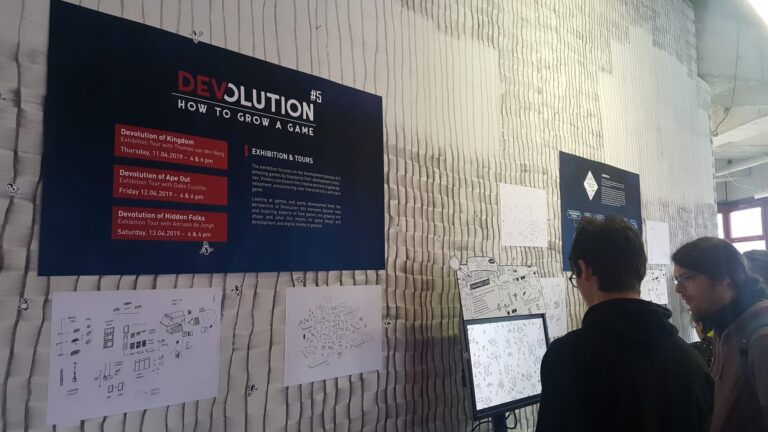
From April 11 to 13, 2019, Devolution #5 took over a corner of A MAZE. / Berlin at the SEZ. For the first time, we showed not one game but three: Kingdom, Ape Out and Hidden Folks. For each one we laid out its development timeline as six playable builds: prototypes, in-between versions and dead ends, side by side. Each developer came to Berlin to guide visitors through their own game’s history.
Our previous editions focused on a single game: The Curious Expedition, Shift Happens, Thumper and SUPERHOT. With three games in one room, visitors could compare how differently games grow into shape, which fit the theme of our Game Design as Gardening Summit on the same Thursday.
This recap covers the exhibition and the six guided tours. The summit and the event as a whole get their own posts.
The Exhibition
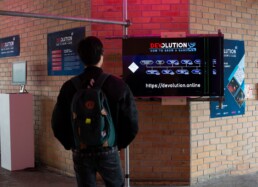
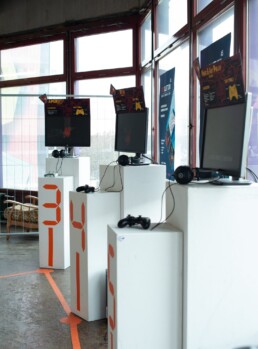
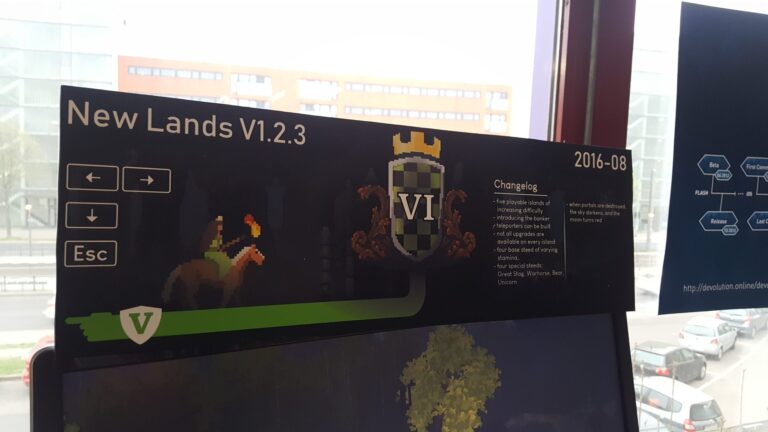
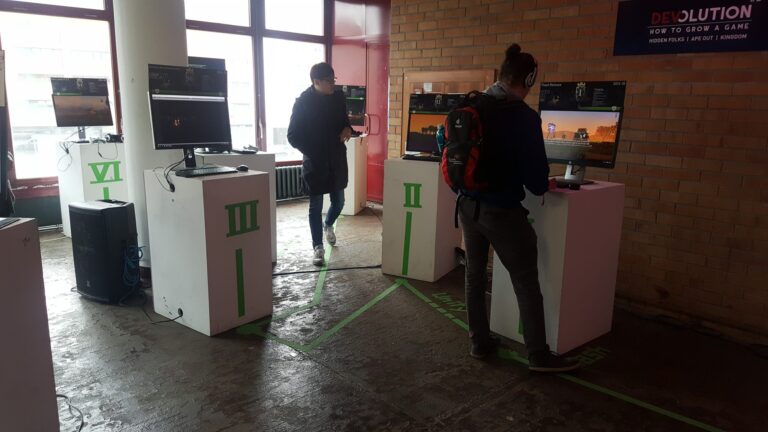
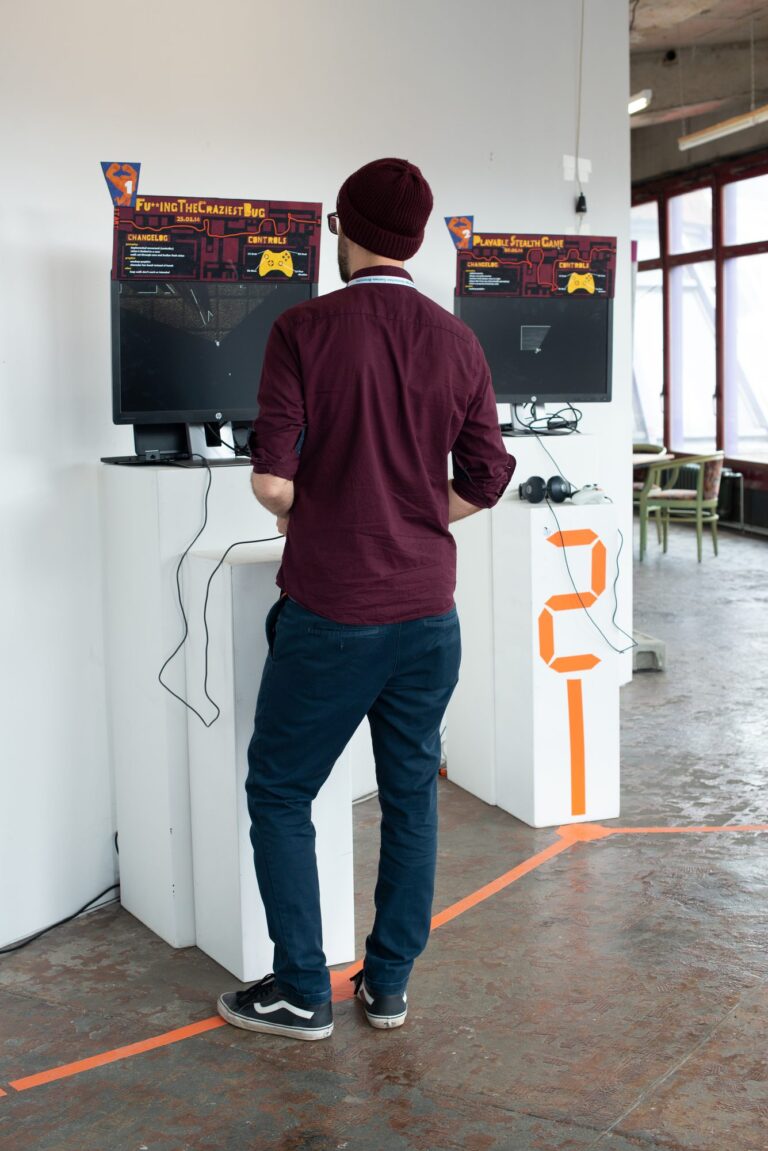
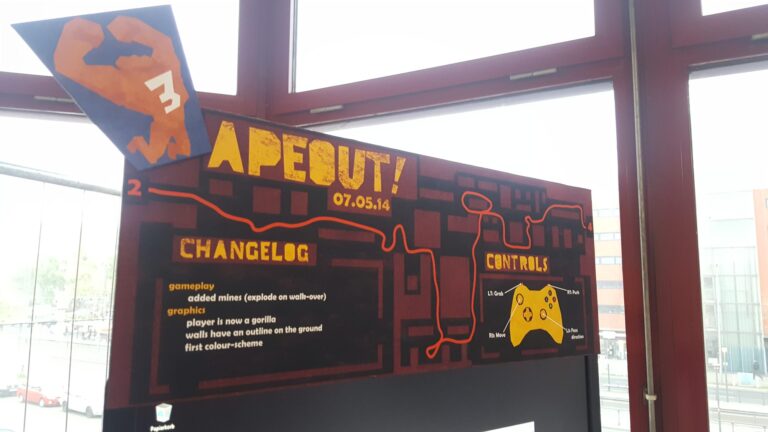
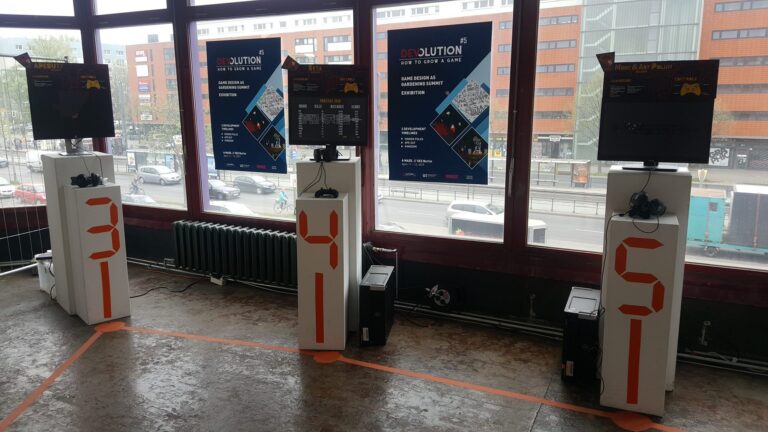
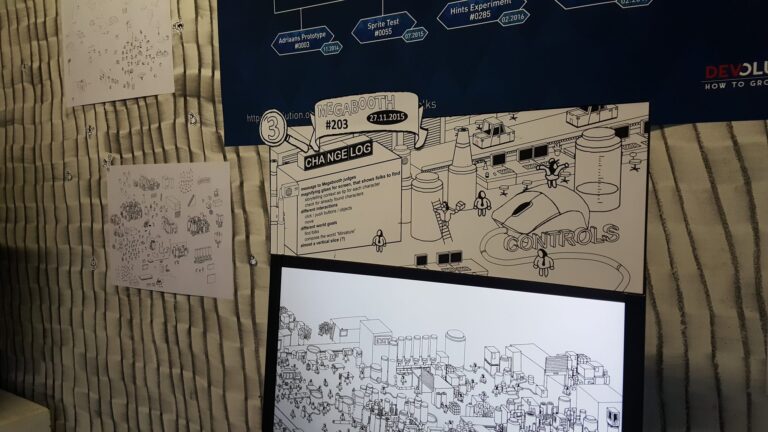
Every game had its own area with six numbered pedestals, one build per pedestal, connected by a line on the floor that you could follow through the game’s history. A sign above each screen showed the build’s date, a short changelog and the controls. Printed changelog booklets, made from the projects’ version control history, let visitors read through every commit. A timeline poster per game completed the picture, along with screens showing the timeline online.
Changelog Booklets
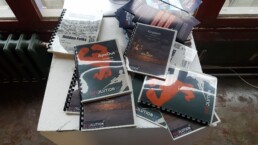
Next to the builds lay ten spiral-bound changelog booklets. We exported each project’s version control history and printed all of it, commit by commit: who made the change, when, and the message they wrote at the time. Visitors could step from a pedestal to the matching booklet and read what the team was working on around that build, from the first commit to the release.
- Kingdom · 4 bookletsFlash, iOS, Unity Part 1 & 2 · Sep 2013 – Feb 2016 · about 2,400 commits
- Ape Out · 3 bookletsBlackout, Ape Out Part 1 & 2 · Feb 2014 – Mar 2019 · about 2,350 commits
- Hidden Folks · 3 bookletsPart 1–3 · Nov 2014 – Mar 2019 · about 3,000 commits
The booklets reproduce the developers’ internal commit messages, so we can’t publish them here. The image shows the real covers and the original page layout, with the commit text replaced by placeholder lines.
Exhibition
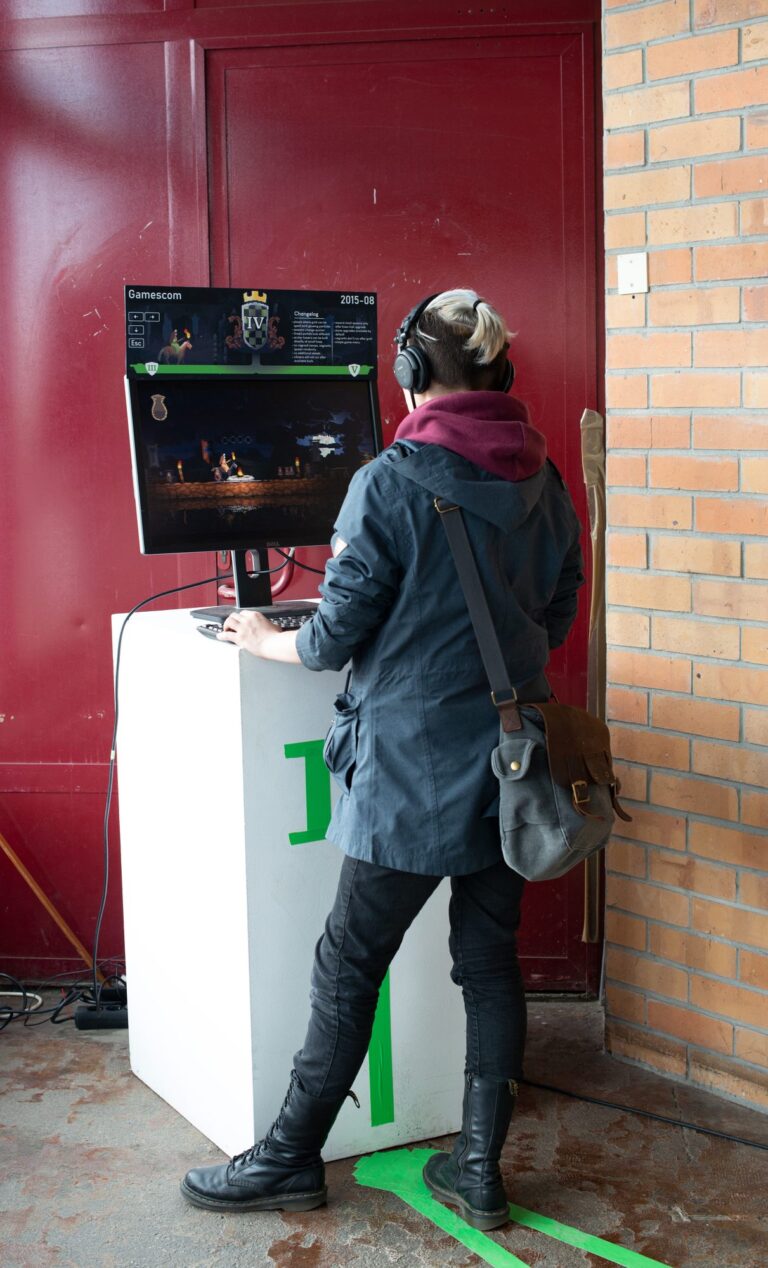
Kingdom is a 2D sidescrolling strategy and resource management hybrid by Thomas van den Berg (noio) and Marco Bancale (Licorice). It started as a small Flash game by noio and went through three technical eras: Flash (from 2012), iOS (from late 2013) and the Unity rewrite (from 2014). The six builds on display were:
- the released Flash version
- the first screen in Unity
- the project in the Unity editor
- the gamescom build (2015)
- Kingdom: Classic
- Kingdom: New Lands (2016)
Development History
We turned the version control history of each game into a Gource visualisation: every dot is a file, every branch a folder, and you can watch who worked on what as the project grows. Kingdom’s history spans three repositories, one for each technical era.
Tours with Thomas van den Berg
Thursday, April 11, 4 pm & 6 pm
Thomas opened by admitting that Kingdom was never meant to be the game it became. He had originally been working on an economic simulation and only added enemies at the last moment:
“Then I added enemies and walls, and it kind of… clicked into place and it became kind of a tower defense game, which was not really what I was working on from the beginning.”
Many of Kingdom’s defining features were discovered rather than designed. The bag of coins that doubles as your health bar came out of a realisation, not a plan: “your health is kind of how much money you have, which was not like a game design decision.”
Several lessons from player testing stuck with the audience:
- Mystery needs visible cause and effect. An early build let you trigger something on the far left of the world that changed something on the far right, with nothing connecting the two. Thomas’s conclusion: “That’s never acceptable.”
- Smarter-looking villagers without smarter AI. Letting characters run to a thrown coin made players see them as far more responsive, “even though we didn’t make the AI any actual smarter.”
- Players run right for a reason. At gamescom, players treated Kingdom like a platformer and kept heading right instead of building. As Thomas put it, “it’s always the fault of the game designer.”
He also talked about scope: before launch he cut his backlog in half again and again, right up to two days before release. He explained why the water takes up a third of the screen without any gameplay purpose: it gives players a moment “to just look at the scenery a little bit and think of what you’ve built.” And he told the story of the ending: the publisher kept asking for a way to win, so Thomas added a boat. “You don’t win, you just leave.”
Listen: Kingdom tour highlights
10 short clips from our recordings of Thomas’s two guided tours through the exhibition on Thursday, April 11 (5:31 in total).
- The tower-defense game he did not set out to make0:34
- Your money is your health0:31
- Players run right for a reason0:32
- Mystery still needs visible cause and effect0:35
- Smarter-looking characters without smarter AI0:33
- Cutting the backlog in half, again and again0:41
- Why the water matters even without gameplay0:42
- A second job meant less pressure0:27
- You do not win; you leave0:23
- The monsters as a reflection of your greed0:33
Exhibition
Ape Out is an intense, colourfully stylised smash ’em up about primal escape, rhythmic violence and frenetic jazz. Development started when Gabe Cuzzillo took game development courses at NYU, including an independent study with Bennett Foddy. Foddy went on to contribute to the game’s art, and Matt Boch worked on its music system and sound design. Ape Out was part of the NYU Game Center Incubator and was partly financed by Indie Fund. Devolver Digital announced it with a playable trailer in March 2017, and the game came out in February 2019, just weeks before the exhibition opened. The six builds on display were:
- “The Craziest Bug”
- “It’s kinda a game”
- “APEOUT!”
- a high-score version
- the first version with Matt Boch and Bennett Foddy on board
- the final game
Next to the builds, a listening station played some of the music that inspired the game, and a bonus station ran on a Raspberry Pi.
Development History
As with Kingdom, this is a Gource visualisation of the project’s version control history. Ape Out’s history spans two repositories: the first from the time the project was still called Blackout, the second leading up to the release.
Tours with Gabe Cuzzillo
Friday, April 12, 4 pm & 6 pm
Gabe opened with how he ended up making games at all. He was in film school when it became clear where that path would lead: graduating, then fetching coffee “for somebody who was editing ads and commercials for like the next five to 10 years.” He took classes at the NYU Game Center instead and started on Ape Out in 2013, about a week after releasing his first game.
The first idea had nothing to do with apes. It was a time-travel stealth game in which every death sent you back as a new infiltrator:
“Turns out time travel is hard.”
What stayed from those early prototypes was the wish to give a top-down game a sense of physicality. In most top-down games of the time, moving your character “almost feels like a cursor.” Grabbing walls led to grabbing guards, pushing them into walls and using them as shields.
Several turning points stood out in the tour:
- A joke became the main character. When Bennett Foddy played the build where you shove guards into walls, he joked that he felt like an escaped gorilla. The remark stuck, and a month later the player was a gorilla.
- Silhouettes as a constraint. As a non-artist, Gabe needed a style he could pull off. Once the gorilla was a single solid colour, it felt more alive, because your brain fills in the gaps in the motion. Saul Bass and Olly Moss posters became the reference.
- A song as a design compass. Pharoah Sanders’ “You’ve Got to Have Freedom” captured the feeling Gabe was after. He cut his NYU Game Center Incubator pitch trailer to it, and from then on every design decision was “gut checked against that feeling.”
- Losing the vision cone. Removing the stealth view cone was “kind of an admission that the game was becoming an action game.” Procedural generation followed, so players could not memorise levels and had to stay reactive.
- From one long escape to an anthology. Around 20 levels of one continuous escape lost all sense of escalation. Gabe cut everything after the first eight levels and turned the game into a series of shorter escapes.
He finished with the collaborators who helped him over the line. Matt Boch built the reactive drum system that plays like a live drummer responding to the action, and working with Matt and Bennett pulled the project out of a two-year rut: “the game gets better even if you don’t work on it.”
Listen: Ape Out tour highlights
10 short clips from our recordings of Gabe’s two guided tours through the exhibition on Friday, April 12 (13:23 in total).
- From film school to the Game Center1:10
- A time-travel stealth game and learning to program1:36
- Adding physicality to a top-down game1:24
- An offhand joke became the gorilla1:08
- Strong silhouettes as an art style for a non-artist1:08
- You've Got to Have Freedom: the game's emotional core1:19
- Why the vision cone had to go1:16
- A drum system that plays like a live drummer1:27
- From one long escape to an anthology1:17
- Collaborators who pulled the game out of a rut1:38
Exhibition
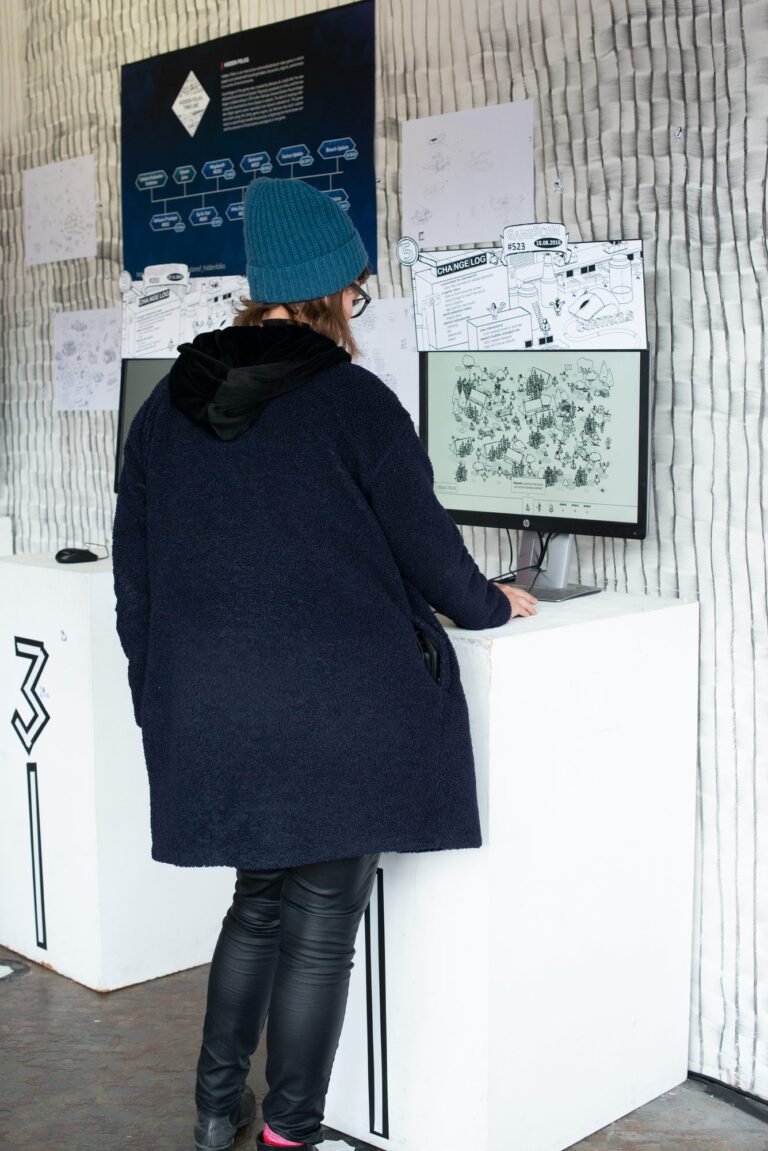
Hidden Folks is an interactive wimmelbilderbuch, a hidden-object game set in hand-drawn miniature worlds. Adriaan de Jongh saw Sylvain Tegroeg’s detailed illustrations at Sylvain’s graduation show, built a first prototype using art from Sylvain’s website, and the two began working together in 2014. The game was built in Unity, with custom tools Adriaan wrote to digitise the hand-drawn art and handle the sheer number of illustrations and objects. The six builds on display were:
- the first playable version (2014)
- the sprite test (2015)
- the MegaBooth build
- the vertical slice
- the gamescom build (2016)
- the Android version on a tablet
Sylvain’s original drawings hung next to the screens.
Development History
As with Kingdom, this is a Gource visualisation of the project’s version control history. Hidden Folks started out under the working title Miniature.
The Evolution of Hidden Folks (2014–2019) · 8:20
Tours with Adriaan de Jongh
Saturday, April 13, 4 pm & 6 pm
Adriaan started with how Hidden Folks almost didn’t happen. He met Sylvain, joked that they should make a game together, and they laughed it off. But the idea stuck with him:
“I kept thinking about his art style. And I also kept thinking about, man, those little miniature worlds.”
One early plan was to generate scenes procedurally. Adriaan spent three months trying to make a scene as beautiful as one Sylvain drew in fifteen minutes, then gave up on the idea: “So that means manual labor. Yay.”
Many of the stories were about small details that took a long time to find:
- A tiny wiggle teaches the player. Clicking a garage door makes it wiggle in the direction it can open. Adriaan called this “a massive epiphany”: everything players can interact with should give them feedback.
- Placeholder sounds that stayed. The game’s famous mouth sounds came from a folder called placeholder sounds. Sylvain and Adriaan yelled into a microphone, “but once we saw it in there, it just really worked.”
- The simple solution that took months. The split into required and bonus targets clearly didn’t work. The fix was simple once found: find enough targets and you can move on.
- Fun for the designers, stressful for the players. A level that scrolled on automatically felt fun to the team, but players found it stressful in a game that’s otherwise about taking your time.
He finished with an honest look back after five years with the game: proud of it, glad it exists, and “so done with it.”
Listen: Hidden Folks tour highlights
10 short clips from our recordings of Adriaan’s two guided tours through the exhibition on Saturday, April 13 (5:56 in total).
- Programming passion, burnout, and learning to live again0:22
- The accidental success that funded three years0:39
- A joking invitation became a creative partnership0:38
- When an artist is faster than the algorithm0:37
- A tiny wiggle teaches the player0:31
- The placeholder mouth sounds that stayed0:37
- The simple solution that took months to find0:42
- Fun for the designers, stressful for the players0:41
- Why he felt ready to release without a publisher0:33
- Being proud of a game and ready to stop0:36
Thank You
A huge thank you to Thomas, Gabe, and Adriaan for opening up their projects, to everyone who joined the tours, and to A MAZE. / Berlin for hosting us again.
More about Devolution #5: the whole event (Recap) · Game Design as Gardening Summit (Recap)